Why a Single Professional Facial Outperforms Months of At-Home Device Use: The Clinical Explanation
The Frustration Is Valid—And the Answer Is More Nuanced Than Marketing Suggests
You purchased the LED mask. You added the microcurrent wand. Perhaps you even invested in a high-frequency device that promises to replicate what professionals do in a clinical setting. And yet, after a single appointment at a dermatology clinic or medical spa, your skin looks measurably better than it has in months of diligent at-home effort.
This is not a coincidence, and it is not simply a matter of your imagination responding to the atmosphere of a professional environment. There are concrete, clinically grounded reasons why professional treatments consistently produce superior outcomes—and understanding those reasons may be the most valuable skincare education you receive this year.
The Concentration Gap That No Consumer Product Can Close
At the core of the professional-versus-consumer divide lies a straightforward regulatory reality: the concentrations of active ingredients available to licensed professionals are substantially higher than what the FDA permits in over-the-counter products.
Consider chemical exfoliants as a representative example. A consumer-grade glycolic acid product available at a pharmacy or beauty retailer is typically formulated at two to ten percent concentration. A licensed aesthetician or dermatologist, depending on the state and their credentials, may apply solutions ranging from thirty to seventy percent or higher in a controlled clinical environment. The physiological effect of that difference is not incremental—it is categorical.
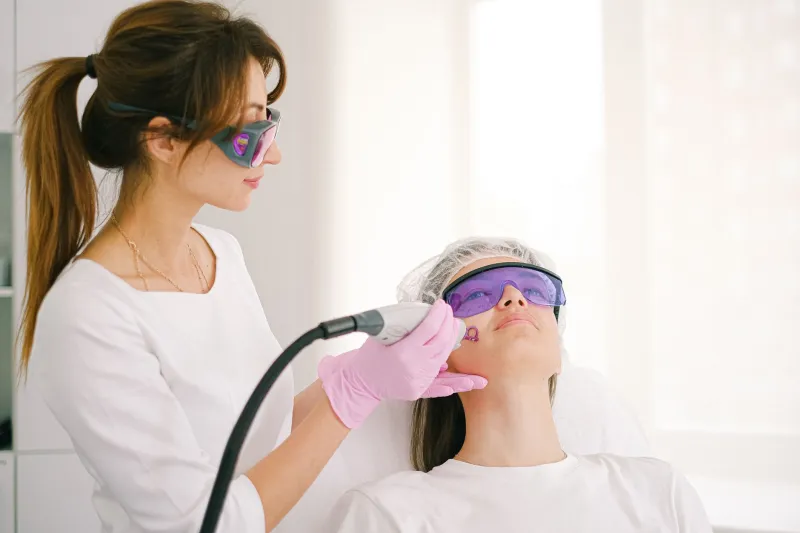
The same principle applies to devices. Consumer LED panels operate at energy outputs and wavelengths calibrated for safety during unsupervised home use. Professional-grade phototherapy equipment delivers light at intensities and durations that would be inappropriate without clinical oversight, precisely because they produce meaningful biological changes in skin tissue. When patients describe their at-home device as doing "basically the same thing" as a professional treatment, the comparison is technically inaccurate in ways that matter enormously to outcomes.
Real-Time Skin Assessment Changes Everything
One of the most underappreciated advantages of a professional facial is not a product or a device at all—it is the trained eye performing the treatment.
A skilled aesthetician or dermatologist assesses your skin continuously throughout a session. They observe how your skin responds to each step, adjust pressure, timing, and product selection accordingly, and make decisions in real time that no pre-programmed device can approximate. If your skin shows signs of sensitivity mid-treatment, a professional modifies the protocol. If your barrier appears more compromised than usual on a given visit, they may choose to forego a planned exfoliation step entirely.
At-home devices, by contrast, apply a fixed, standardized output regardless of your skin's condition on any particular day. They cannot distinguish between a barrier that is ready to tolerate stimulation and one that is already stressed. This absence of adaptive intelligence is not a minor limitation—it is a fundamental structural difference between consumer and professional care.
The Technique Variable Patients Consistently Underestimate
Application technique is a subject that skincare marketing rarely addresses honestly, because acknowledging its importance would undermine the premise that consumers can achieve professional results independently.
Manual lymphatic drainage, performed correctly during a professional facial, requires an understanding of facial anatomy and lymphatic pathways that takes years of training to develop. Extractions—when clinically appropriate—demand precise pressure, proper tool use, and knowledge of when not to proceed, all of which prevent the scarring and post-inflammatory hyperpigmentation that frequently result from at-home attempts. Even the application of a simple sheet mask benefits from professional assessment of which formulation is appropriate for your current skin condition.
Consumer devices sidestep the technique variable by design, because they must be usable by individuals with no clinical training. That design constraint, while responsible from a safety standpoint, necessarily limits what those devices can accomplish.
What Happens in the Days Following a Professional Treatment
The results patients observe immediately after a professional facial are only part of the picture. Many professional treatments initiate biological processes—collagen stimulation, accelerated cellular turnover, lymphatic drainage—that continue to produce improvements for days or weeks following the appointment.
Microdermabrasion, for instance, triggers a wound-healing response that prompts the skin to generate new collagen. Professional-grade ultrasound treatments stimulate fibroblast activity at depths that consumer devices cannot safely reach. These downstream effects are part of what patients are purchasing when they invest in a professional treatment, and they represent a category of benefit that at-home devices are not designed to deliver.
So Where Does That Leave Your At-Home Device?
None of this is an argument that consumer devices are worthless. Consistent at-home use of a well-designed LED device or a properly calibrated microcurrent tool can support skin health, particularly as a maintenance strategy between professional appointments. The clinical evidence for certain wavelengths of red light in reducing inflammation and supporting collagen synthesis, for example, is reasonably well established.
The distinction that matters is between maintenance and treatment. At-home devices are most appropriately understood as tools for sustaining the results achieved through professional care, not for generating those results independently. When patients approach consumer devices with that expectation, they are far more likely to feel their investment was justified.
The Budget Question Deserves an Honest Answer
For patients weighing whether professional facials deserve a permanent line in their skincare budget, the honest clinical answer depends on what you are trying to accomplish.
If your primary concern is maintaining a healthy barrier, managing mild dryness, or supporting general skin wellness, a thoughtfully chosen at-home routine supplemented by occasional professional visits may be entirely sufficient. If you are managing acne, hyperpigmentation, early signs of aging, or a diagnosed skin condition, professional treatments are not a luxury—they are the mechanism through which meaningful clinical improvement actually occurs.
A $300 at-home device purchased in place of professional care is a different investment than the same device purchased in addition to periodic professional appointments. The former is unlikely to deliver the results patients hope for; the latter can be a genuinely useful component of a comprehensive skin health strategy.
The Takeaway From a Clinical Standpoint
The gap between professional facials and at-home devices is not primarily a marketing illusion or a matter of placebo effect. It reflects real differences in ingredient concentrations, device output, real-time clinical assessment, and application technique that are built into the regulatory and professional training frameworks governing both categories.
Understanding what you are actually paying for when you book a professional treatment—and what you are not getting when you rely exclusively on consumer devices—is the kind of clarity that leads to better skincare decisions and, ultimately, better skin.